





How Barclays shares data in a regulated environment
All businesses, regardless of industry, need to comply with data protection laws, such as the General Data Protection Regulation (GDPR), as well as requirements to report health and safety data, pay equality, etc. Specific industries are also subject to regulation and laws that require them to collect and share data with regulators.
- Sharing data is a legal requirement in some industries. Regulators can require businesses to share data with them, with other companies or with the public.
- Beyond being a legal requirement, regulated data sharing often creates benefits for the organisations that share the data, as well as others in their industry and consumers.
- Barclays shares data in accordance with the Second Payment Services Directive (PSD2) and open banking regulations, which allows banking customers to more easily share personal data between authorised organisations online.
- Barclays saw the benefits of being a leader in open banking early and, to better serve its customers, provided account aggregation services before most other banks.
- Barclays also engaged in an open-innovation initiative to produce innovative new services by bringing new talent and ideas into its data ecosystem.
Every business is subject to regulation governing how it collects, uses and shares data.
All businesses, regardless of industry, need to comply with data protection laws, such as the General Data Protection Regulation (GDPR), as well as requirements to report health and safety data, pay equality, etc. Specific industries are also subject to regulation and laws that require them to collect and share data with regulators.
For example, pharmaceutical, pharmaceutical and pharmaceutical businesses need to share data about the environmental and health impacts of their products. Transport companies are increasingly required to share data about fares and timetables. Water companies are required to provide detailed information about their environmental impact, supply reliability and availability.
Regulatory compliance is necessary for companies to continue operating within their industry, though this is sometimes portrayed as an unwelcome obligation, the need to comply with regulation can be an opportunity to re-engage with customers and to drive innovation.
Clear and visible support for data protection regulation can help build trust with consumers. Embracing data-sharing provisions in regulation – specifically the data portability right included in GDPR – can allow companies to explore new ways to attract and retain customers. Regulation intended to increase market competition can create opportunities for existing providers and not just new entrants.
How Barclays is benefiting from sharing data as part of open bankingThe Second Payment Services Directive (PSD2) and open banking regulation in the UK requires banks to publish standardised open data about banking products, branches and ATMs, facilitate permissioned access to customer account data, and provide wider access to payment services between banking providers.
The regulations are aimed at creating opportunities for third party providers to create new services for banking customers, including account aggregation, budgeting support and the ability to switch banking providers more easily. However, they also offer existing providers, like Barclays, an opportunity to offer a new range of innovative products to their customers.
Like the other main UK banks, Barclays was required to implement the standard set of application programming interfaces (APIs) described by the legislation. The Open Banking Implementation Entity, responsible for overseeing implementation of the regulation, worked with the banks to design the technical standard and to support adoption.
Barclays saw extra potential in implementing the standard, allowing it to build on its existing accelerator and open innovation programmes, explore new products and build confidence with customers.
Going beyond simply implementing the standard, Barclays also developed a new consumer-focused data aggregation tool. The tool allows existing Barclays customers to view their accounts from as many as eight other banks within the existing Barclays mobile app.
In addition to supporting its own product development, the APIs allow Barclays to work more closely with a range of financial technology (fintech) startups.
What are the benefits of sharing data via the Open Banking Standard?Barclays has long supported the growth of innovative fintech businesses via its accelerator and open innovation programmes. In addition to providing funding and expertise, startups have been able to work with Barclays to get access to anonymised data which helps explore and test new product ideas.
The open banking APIs provide Barclays with a new means of working with startups through standardised APIs, rather than bespoke data sharing. Knowledge of the Open Banking Standard in the fintech community allows Barclays to engage with an experienced set of startups, potentially reducing time for new products and partnerships to reach the market. Startups using data via Barclays APIs include:
- Chip an app which uses an algorithm to analyse a customer’s spending and work out how much they can afford to save each month, and then transfers that amount to a Barclays instant-access account.
- Bean , an app allowing customers to compare deals on their household bills, track payments and cancel unwanted subscriptions from a simple dashboard.
- Money Box, an app enabling people to round up the cost of digital payments and invest the spare change, helping people to build savings via micro-payments.
By increasing access to data across the industry, open banking has the potential to allow banks to benchmark their products and services against competitors, reach new customers more easily through affiliated third party services, and to more easily access the necessary evidence for fraud prevention checks and customer identity verification – known as Know Your Customer (KYC).
Understanding the Open Banking Standard, both as a provider of APIs and a consumer of data, means Barclays is in a strong position to understand, explore and capitalise on the benefits of wider industry adoption.
Quickly integrating support for the standard into its existing tools and working to build customer confidence and trust will also help Barclays retain or attract new customers.
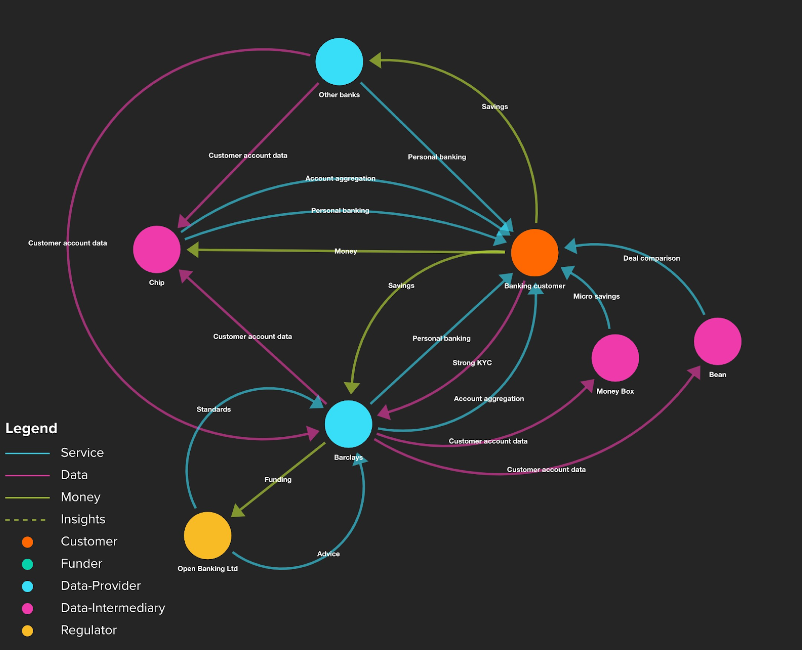
Open banking allows customers to authorise the sharing of personal data with trusted third parties such as Chip, Bean and Money Box. These startups work with Barclays to deliver innovative solutions to Barclays customers, such as account aggregation, financial management and utility product comparison.
When customers authorise other banks to share data with Barclays, they are also able to take advantage of new Barclays open banking-powered products such as account aggregation.
How is the data being shared?Barclays is publishing data via the Open Banking Standard which defines a set of common APIs that provide access to third-party providers like Chip, Bean and Money Box.
Customers authorise access and grant consent for Barclays or other data users to access personal data about them. This supports third-party providers in developing innovative products and services for Barclays customers.
